
Bridgewater Township Previous-Resident Sources
Different eras leave different evidence for previous residents. Current parcel geography and land records establish a property connection. Regional directories and newspapers can supply household-era leads. State archives and local repositories take the trail into earlier Bridgewater history. Start with the period in question, then select a source that records that period rather than trying to force a modern index to answer an eighteenth-century question.
| Source route | Years or era | Where held | What it can show |
|---|---|---|---|
| Somerset County Clerk regular index | Guidance from January 1, 1977 | Acclaim, Records Room, or copy order | Recorded deeds, mortgages, liens, releases, maps, and dated parties. |
| Acclaim Alpha Index | Pre-1977 research route | County Clerk’s older-name index | Volume and surname leads for earlier instruments. |
| Regional directory runs | Somerville 1917-1984; Plainfield 1902-1982; New Brunswick 1968-1987 | Somerset County Library System | Address, business, or name leads under each edition’s place label. |
| Bridgewater tax ratables | 1779, 1781, and 1784-1809 | New Jersey State Archives finding aid | Dated taxable-person and property context. |
| Overseers of the Poor papers | 1704-1874, primarily Bridgewater | Somerset historical archival collection | Agreements, orders, examinations, residency, removal, and related historical records. |
| Newspapers, cemetery, and family files | Collection-specific dates | Library, Historical Society, and cemetery sources | Dated notices, burial context, correspondence, maps, and family research leads. |
The table is an era map, not a list of past households. A regular Acclaim result begins the recorded-instrument trail, while the Alpha Index handles the older search route. A directory or tax-ratable hit becomes stronger when its place name, address, year, and role agree with another independent source.
Bridgewater Township Previous-Resident Deed Trail
A land-record trail follows ownership and transactions, not every person who occupied a home. First confirm the parcel with the county map and seek the relevant tax or assessment record from the municipal office when a year and block/lot are known. Then use the legal description, block/lot, name, book/page, or instrument number in the County Clerk index. The Somerset County Clerk Land Records office records deeds, mortgages, tax liens, and related instruments, and its Records Room is open for inspection. Staff can explain the computerized index but do not conduct title searches.
- Locate the address in the Somerset County Tax Parcel Viewer and preserve the block/lot, municipality, property class, and map date. The public viewer redacts owner names.
- Use the Bridgewater Tax Assessor office, county tax material, or a narrow OPRA request for the relevant tax-list record if the person-name bridge is not public in GIS.
- Search the Acclaim land-record index by legal description, block/lot, name, book/page, document type, or instrument number. Copy each party role and recording date as displayed.
- For a purchase instrument, follow the prior party only after comparing the legal description and date. Repeat the process backward rather than assuming an identical name identifies the same person.
- Move to Acclaim’s Alpha Index for pre-1977 name research. It uses an AZ Volume selector, a required last name, and an optional first name.
Online use is free for the index. A free account is needed for document images, which are unofficial copies. The research reports regular Records Room copies at $.07 per page and certified copies at $10 per instrument plus $1 per page. Certified copies can be ordered online or at the office. A record trail should distinguish a transfer date from an occupancy date.
Note: A complete title opinion requires more than a partial public-index review and should not be inferred from a short chain of search results.
Bridgewater Township Previous-Resident Terms
These terms help keep a house-history search precise. They describe the records that form a Bridgewater Township previous residents trail without treating an old name as a current address claim.
- Grantor
- The party transferring an interest in a recorded instrument.
- Grantee
- The party receiving an interest in a recorded instrument. In a purchase deed, the grantee may be found as a prior grantor in an earlier transaction.
- Chain of title
- A sequence of recorded land transactions connecting interests over time. It is not the same as a household history.
- Legal description
- The recorded land description, often more stable than a street address when routes, labels, or jurisdictions change.
- Criss-cross directory
- An address-arranged directory when a verified historical edition supplies one. Cite its city, year, and edition before relying on the entry.
- Enumeration district
- A census-area label used to locate material for a defined census year. It is not a permanent neighborhood name.
Do not replace the original wording in an old document. A grantee mailing field may be outside Bridgewater, and a property address may have a different postal label. Record both fields with their source date.
Bridgewater Township Past Directory Crosswalk
No official Bridgewater-specific city-directory run was located in the reviewed collection descriptions. The useful local route is regional. The Somerset County Library System lists Somerville city directories from 1917 to 1984, Plainfield directories from 1902 to 1982, and New Brunswick directories from 1968 to 1987. A result should always retain the edition’s actual city, year, and page or film reference. A Somerville entry is a lead to compare, not automatic proof of a Bridgewater address.
The Library of Congress city-directory guide is a second collection route. Its national holdings are primarily 1861 to 1960 and include supplemental New Jersey directories microfilmed by historical societies. Requests should state directory type, location/state, and the specific years wanted. The guide also says staff do not search the directories for individual names, so a request needs enough detail to identify the desired volume.
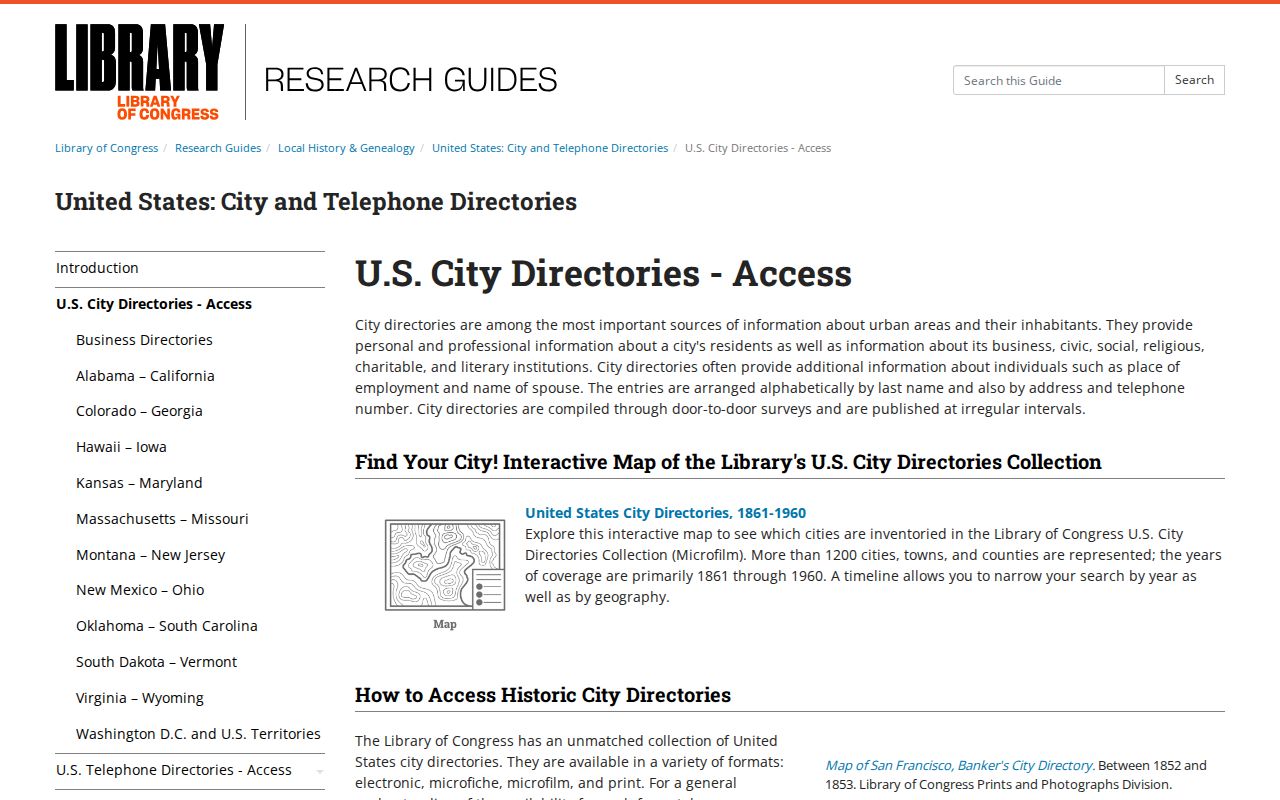
The collection guide is useful for identifying a directory route and its limits. It does not turn a regional or supplementary directory into a comprehensive Bridgewater resident roster.
When a directory lead names an address, compare it to the record’s place label, date, occupation or business context where present, a map, newspaper notice, deed, or tax record. The related collections, editions, and access details are covered on the Bridgewater Township city directory page.
Bridgewater Township Previous Census Dates
Previous residents research gains strength from a dated flow rather than a single name hit. A directory, clipping, or newspaper reference can show a household or activity at one time. A tax record or deed can show a property connection at another time. Where a federal census schedule is available for the era, pair its census year with the directory year and preserve each repository’s citation. Cemetery, probate, or historical-society material may help explain where the trail ends.
- Start with the address as written in the dated source, including any Somerville, Raritan, Finderne, Martinsville, Bound Brook, or rural-route label.
- Find the matching period in a regional directory, newspaper microfilm, clipping file, or historical collection. Record the edition, date, page or film, and exact spelling.
- Compare the same period with an available census schedule, tax-ratable, deed, probate, cemetery, or map source only when its date and jurisdiction fit the question.
- Mark the result as a dated household lead, property connection, burial record, or published notice. Do not compress those labels into “lived here.”
The Somerset County Library System holds Courier-News affiliated titles from June 2, 1884 to the present, Messenger-Gazette from October 16, 1823 to June 2007, as well as Bridgewater clippings on microfilm and local maps. The cited Census QuickFacts series is aggregate population context, not a household schedule. These sources are especially useful when a regional directory uses a nearby-city label or when an address has changed form over time.
Bridgewater Township Previous Jurisdictions
Bridgewater was chartered in 1749 and incorporated in 1798. Somerville and Raritan were once part of the township and later became separate municipalities. This is a practical previous-residents issue, not just background. An older record may use Bridgewater for a place that is now in another municipality, while a regional directory may use a post-office or nearby city label. Build a jurisdiction crosswalk before deciding that an old street or household belongs to the modern township.
The New Jersey State Archives identifies Bridgewater ratable books for 1779, 1781, and 1784 through 1809. Its Somerset County Overseers of the Poor material spans 1704 to 1874 and is primarily Bridgewater, with agreements, orders, examinations, indentures, residency, removal, relief, and apprenticeship records. These documents can illuminate movement and family circumstances in their historical setting. They are not modern address records and should never be presented as a current resident result.
Note: Record the year, county, township, volume, page, and the person’s exact role before connecting an early record to a house history.
Bridgewater Township Previous Residence Clues
The Somerset County Historical Society operates the Van Horne Library in Bridgewater and has more than 1,300 bound volumes, more than 400 family files, manuscripts, photographs, maps, microfilm, early deeds, and correspondence. Its research service has limited capacity and reports a five-to-eight-week turnaround. A focused house-history request should identify the address, known dates, and desired categories, such as deeds, maps, tax references, family files, newspaper mentions, and cemetery references.
Cemetery material can close or sharpen an older trail. The Master Plan names eleven historic or family cemeteries: Bolmer, Castner-Compton, Lane, Mountain Top, Prince Rogers, Vanderveer #1, Vanderveer #2, Van Pelt, VanVeghten-Davis, VanVeghten-Smith, and Williamson-Ten Eick. The Bridgewater Hill search is record-specific and uses last, first, middle, birth/death, row, and stone fields. A cemetery non-result does not show that a person was not buried elsewhere in the township.
Historical sources also document community memory. The February 2026 Bridgewater Township Council minutes discuss Hobbstown, Macedonia Baptist Church, and Prince Rodgers Cemetery. They state that Prince Rodgers was born enslaved in Bridgewater in 1815, was freed in 1839, and served in the U.S. Colored Troops. Use the official minutes and repository records for the full context, without adding details beyond the source.
Bridgewater Township Previous-Resident Map Caution
Sanborn fire-insurance maps can be helpful only after a precise town and sheet are verified. The reviewed local material cites an 1890 Sanborn map for a nearby Bound Brook church and graveyard. That reference proves the series can matter to the area; it does not establish a Bridgewater Sanborn run. Check the Library of Congress Sanborn collection for the exact community and year before adding it to a previous-residents trail.
For an unverified Bridgewater map, use the Master Plan, tax maps, deeds, regional directories, newspapers, and Historical Society holdings first. Historical street names, village labels, and legal descriptions often supply a more reliable bridge than a map assumed to exist.
Limits on Bridgewater Township Previous Residents
House-history research is a dated exercise, not a way to assemble a living household profile. A deed identifies parties to a transaction. A tax record identifies fields for a stated year. A directory, newspaper, cemetery, or poor-law paper has its own coverage and purpose. None automatically proves who occupied a private address at another date, and a missing hit may reflect an incomplete run, a variant spelling, a separate jurisdiction, or restricted access.
Use old records for family history, estate or heir questions, local history, and personal property context. Keep sensitive details to a minimum and use only lawful channels. Do not use a previous-residents trail to stalk, harass, intimidate, or harm anyone.
Lawful use. Bridgewater Township house-history records are for lawful personal research. Never use a deed, directory, archive, or cemetery lead to harass or track a living person.